AI image generation has changed the way people create content.
A few years ago, making a professional-looking business poster meant opening Photoshop, Canva, or another design tool, finding the right template, adjusting fonts, placing a logo, choosing images, and spending a good amount of time getting everything aligned.
Today, you can simply describe what you want to an AI tool and get an image in seconds.
ChatGPT and Google Gemini have pushed this technology forward in a big way. Both platforms can generate impressive images, edit photos, understand detailed prompts, and create visuals for everything from social media posts to marketing campaigns.
But there is an important difference between generating an image and creating a business design that is ready to use.
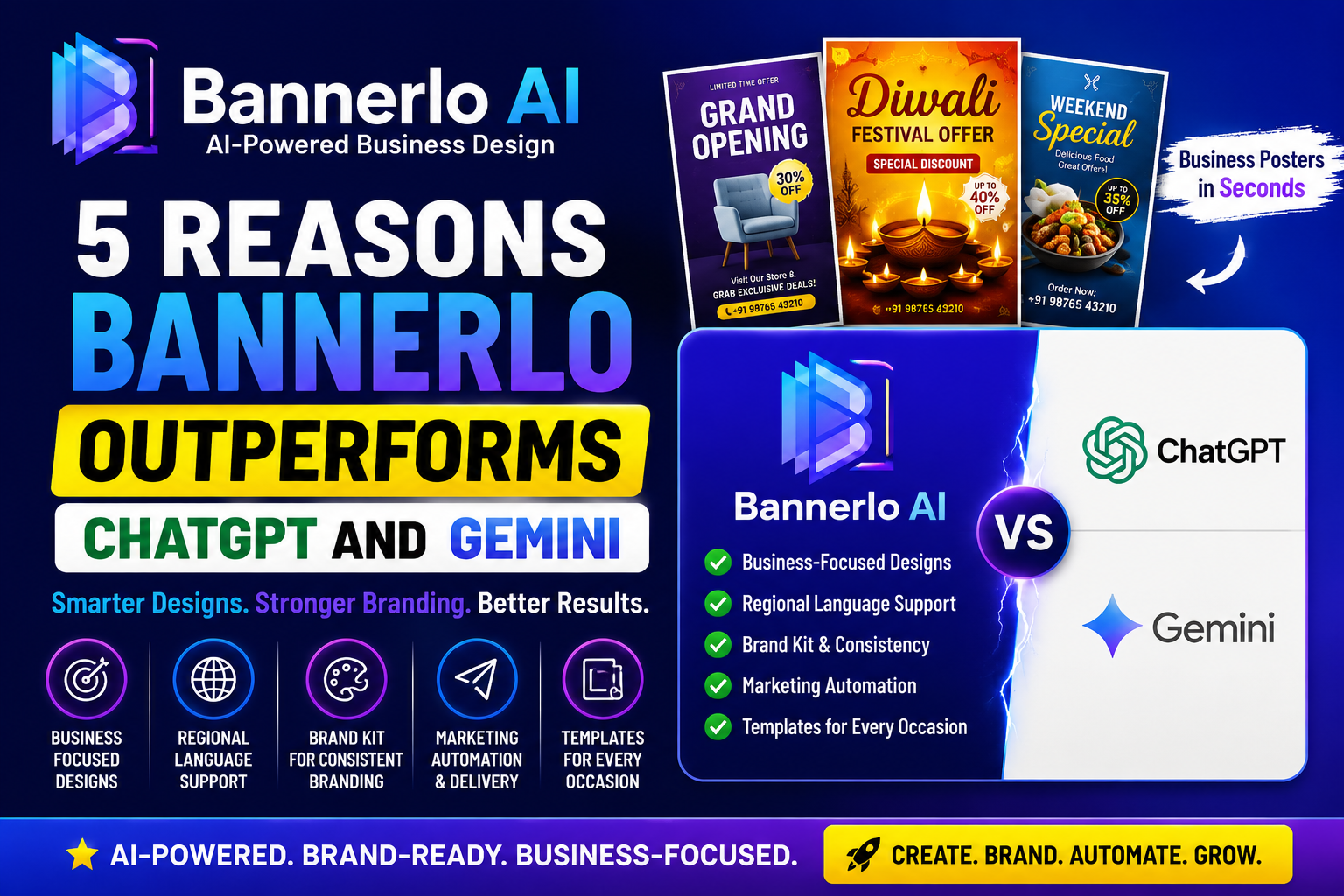
That is where Bannerlo AI takes a different approach.
Bannerlo is built specifically around business creatives—posters, banners, invitations, social media graphics, logos, business cards, festival greetings, and promotional designs. Instead of treating design as just another AI-generation task, Bannerlo tries to turn it into a simpler business workflow.
So, why can Bannerlo be a better choice than ChatGPT or Gemini for business owners and marketers?
Here are five reasons.
1. Bannerlo Is Built for Business Designs, Not Just Image Generation
The biggest difference is the starting point.
ChatGPT and Gemini are general-purpose AI assistants. Their image-generation capabilities are part of much larger platforms designed to help users with writing, research, reasoning, coding, brainstorming, image creation, and many other tasks.
That flexibility is incredibly useful.
But sometimes you don't need an AI assistant.
You just need a poster.
Imagine you run a local restaurant and want to promote a weekend offer.
With a general AI tool, you might write something like:
“Create a modern promotional poster for my restaurant offering 20% off this weekend.”
You may get a beautiful image—but you still need to think about your business name, offer, contact information, branding, dimensions, typography, and how the design should work across different platforms.
Bannerlo approaches the problem differently.
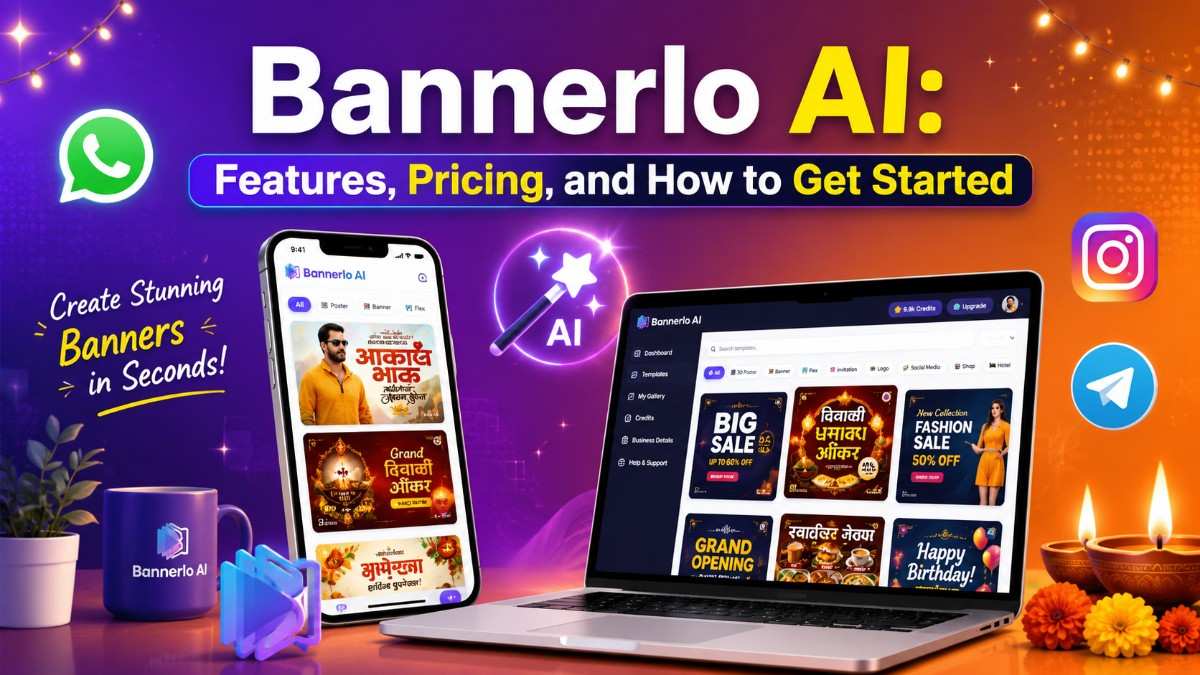
Its workflow asks for practical business information such as the business name, offer, and contact details, then generates designs around those details. The platform specifically presents this as a three-step process: enter details, generate designs, and select/download the result.
That sounds like a small difference.
For a business owner creating content every week, it is actually a major one.
Bannerlo isn't simply asking, “What image do you want?”
It's asking:
“What are you trying to promote?”
2. It Understands the Reality of Indian Businesses
This is probably one of Bannerlo's biggest advantages.
A lot of AI design tools are built for a global audience. That's not necessarily a problem, but the needs of an Indian small business can be very different.
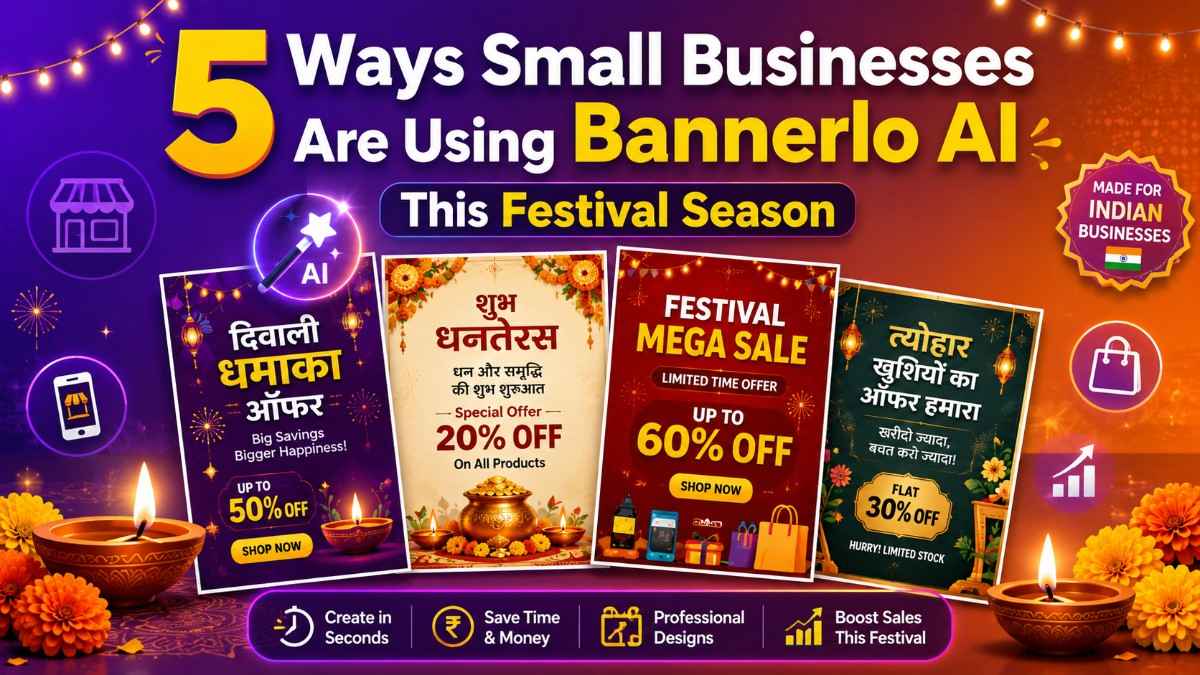
A local sweet shop might want a Diwali promotion in Marathi.
A clothing store might want a sale poster in Hindi.
A restaurant might need a festival greeting in Gujarati.
A local service provider may want a promotional graphic that mixes English with a regional language.
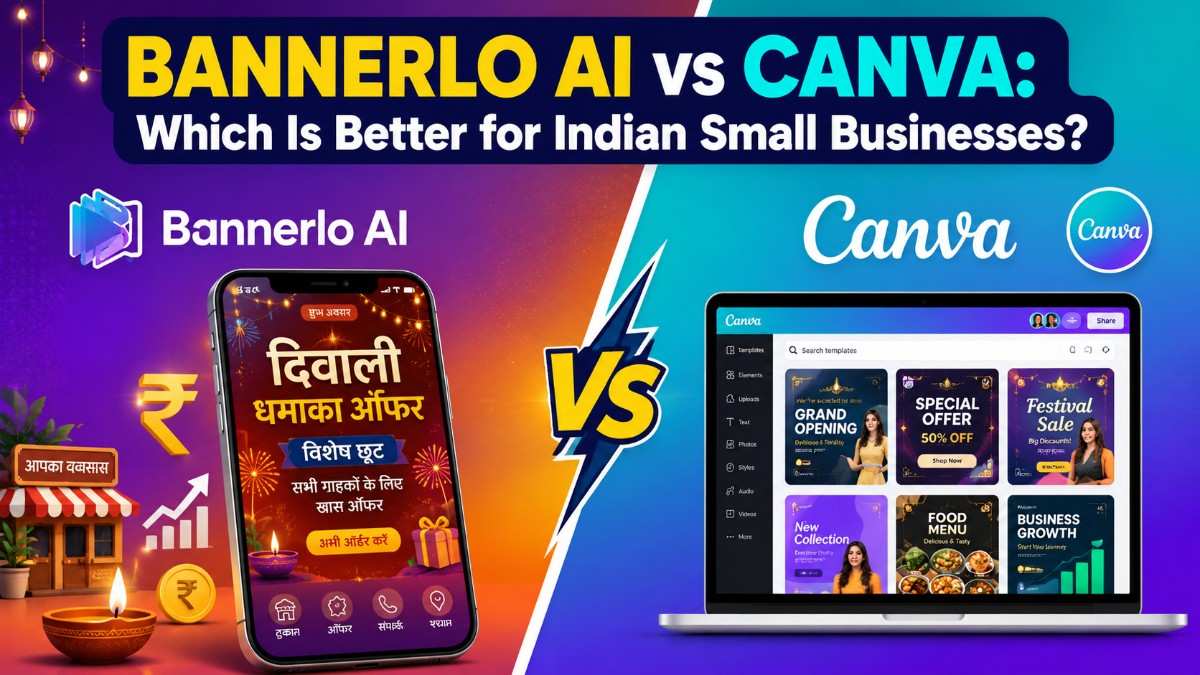
Bannerlo explicitly supports multiple Indian regional languages, including Hindi, Marathi, Bengali, Telugu, Tamil, Gujarati, Urdu, Kannada, Odia, Malayalam, and Punjabi. Its website also highlights typography support for regional-language content.
That's important because language isn't just about translation.
Design has to respect the script.
The spacing, hierarchy, typography, headline length, and visual balance all change when you move from English to Devanagari, Gujarati, Tamil, Telugu, or another script.
For Indian small businesses, that makes Bannerlo's positioning much more practical.
Instead of creating an image first and figuring out the local-language design later, the language can be part of the creative workflow from the beginning.
3. Brand Consistency Is Built Into the Workflow
Here's a problem that many small businesses eventually face.
They create one poster.
Then another.
Then another.
But every poster looks slightly different.
The logo moves around.
The colors change.
The font changes.
The business name is displayed differently every time.
After a few months, the brand starts looking inconsistent.
Bannerlo addresses this with its Automated Brand Kit.
The platform allows users to save brand colors, logos, and fonts so they can be applied across designs and templates. It also describes a Smart Brand Kit where users can upload their logo and business details once and reuse them for future creatives.
This changes the workflow from:
Create → redesign → remember branding → fix mistakes
to:
Set up brand once → create repeatedly
That's a much more scalable approach.
For a single person creating occasional graphics, this might not seem revolutionary.
For a restaurant, retailer, agency, freelancer, or small business creating dozens of posts every month, it can save a surprising amount of time.
And more importantly, it helps every design feel like it belongs to the same brand.
4. Bannerlo Connects Design With Marketing Automation
This is where Bannerlo starts moving beyond traditional AI image generation.
Creating a poster is only one part of marketing.
The next question is:
What happens after the poster is created?
Bannerlo's feature set is designed around that larger workflow.
The platform promotes social-media automation, WhatsApp and Telegram delivery, push notifications, team collaboration, and scheduled festival greetings.
That means the idea isn't simply:
AI → Image
It's closer to:
Business information → Design → Branding → Delivery → Marketing
That distinction matters.
A business owner doesn't ultimately want a folder full of AI-generated images.
They want customers to see their offer.
They want a festival greeting published on time.
They want a promotional poster delivered to their team.
They want content ready for social media.
That's why a specialized platform can sometimes outperform a much more powerful general AI system.
Not because the underlying AI is necessarily “smarter.”
Because the workflow is more focused on the actual job.
5. It Turns Design Into a Repeatable System
This may be the biggest advantage of Bannerlo.
ChatGPT and Gemini are excellent when you want to experiment.
You can brainstorm an idea, generate an image, modify it, try another style, change the background, create a different composition, or ask the AI to produce something completely new. Both platforms have increasingly capable image-generation and editing features.
But businesses often don't need unlimited creativity.
They need consistency.
They need speed.
They need repeatability.
Suppose you own a local business.
You may need:
- Monday promotional post
- Tuesday product post
- Wednesday customer offer
- Thursday festival greeting
- Friday weekend promotion
- Saturday sale banner
- Sunday announcement
Doing this manually every week becomes repetitive.
Bannerlo's template-and-business-information approach is designed to reduce that repetition. The website specifically positions the platform around generating business designs quickly, reusable branding, automatic resizing, and marketing automation.
This is an important shift.
AI is no longer just helping you make one image.
It can become part of a repeatable content-production system.
So, Is Bannerlo Actually Better Than ChatGPT and Gemini?
The honest answer is: it depends on what you're trying to accomplish.
If you want a general AI assistant that can research topics, write content, brainstorm ideas, generate images, edit images, answer questions, and help with many unrelated tasks, ChatGPT and Gemini are incredibly powerful options.
But if your primary goal is:
“I run a business and need professional marketing creatives quickly.”
Then specialization becomes a major advantage.
Bannerlo focuses on the space between AI generation and actual business marketing.
Its website combines AI design generation with regional-language support, brand kits, automatic resizing, image upscaling, social automation, messaging integrations, team collaboration, and business-focused templates.
That's a different proposition from simply asking an AI chatbot to generate an image.
The Real Advantage: Less Designing, More Doing
The future of AI design probably isn't about finding the AI that can make the prettiest single image.
It's about finding the system that removes the most work from the entire process.
A restaurant owner doesn't want to become a graphic designer.
A shopkeeper doesn't want to learn prompt engineering.
A freelancer doesn't want to manually rebuild the same client's branding every week.
And a small marketing agency doesn't want to spend hours creating repetitive festival posts.
They want to enter the information, get a professional result, make a few changes if necessary, and publish.
That's the problem Bannerlo is trying to solve.
And that's why, for business-focused creative production, a specialized tool like Bannerlo can outperform broader platforms such as ChatGPT and Gemini—not necessarily by having a better AI model, but by putting the AI inside a workflow designed around the user's actual job.
Final Thoughts
ChatGPT and Gemini have made AI image generation accessible to almost everyone.
Bannerlo is taking the next step in a more specific direction: turning AI-generated visuals into practical business marketing assets.
The difference is subtle but important.
ChatGPT and Gemini ask:
“What would you like to create?”
Bannerlo is closer to asking:
“What does your business need today?”
And for a small business owner who needs to create, brand, resize, distribute, and repeat marketing content every day, that distinction can make all the difference.
Create less from scratch.
Design faster.
Stay on brand.
Market more consistently.
That's where specialized AI design platforms like Bannerlo have an opportunity to stand out.
Discussions